Best Websites, Apps & Courses to Learn Hebrew in 2026–2027 (Teacher Comparison)
Every Hebrew platform solves a different job. Here is our honest teacher comparison—pros, trade-offs, pricing models, and how to combine the best free tools without wasting money.

 By Guy Ben-Moshe & Itzchak PinhasovNative Hebrew teachers from Israel · Teaching since 2012
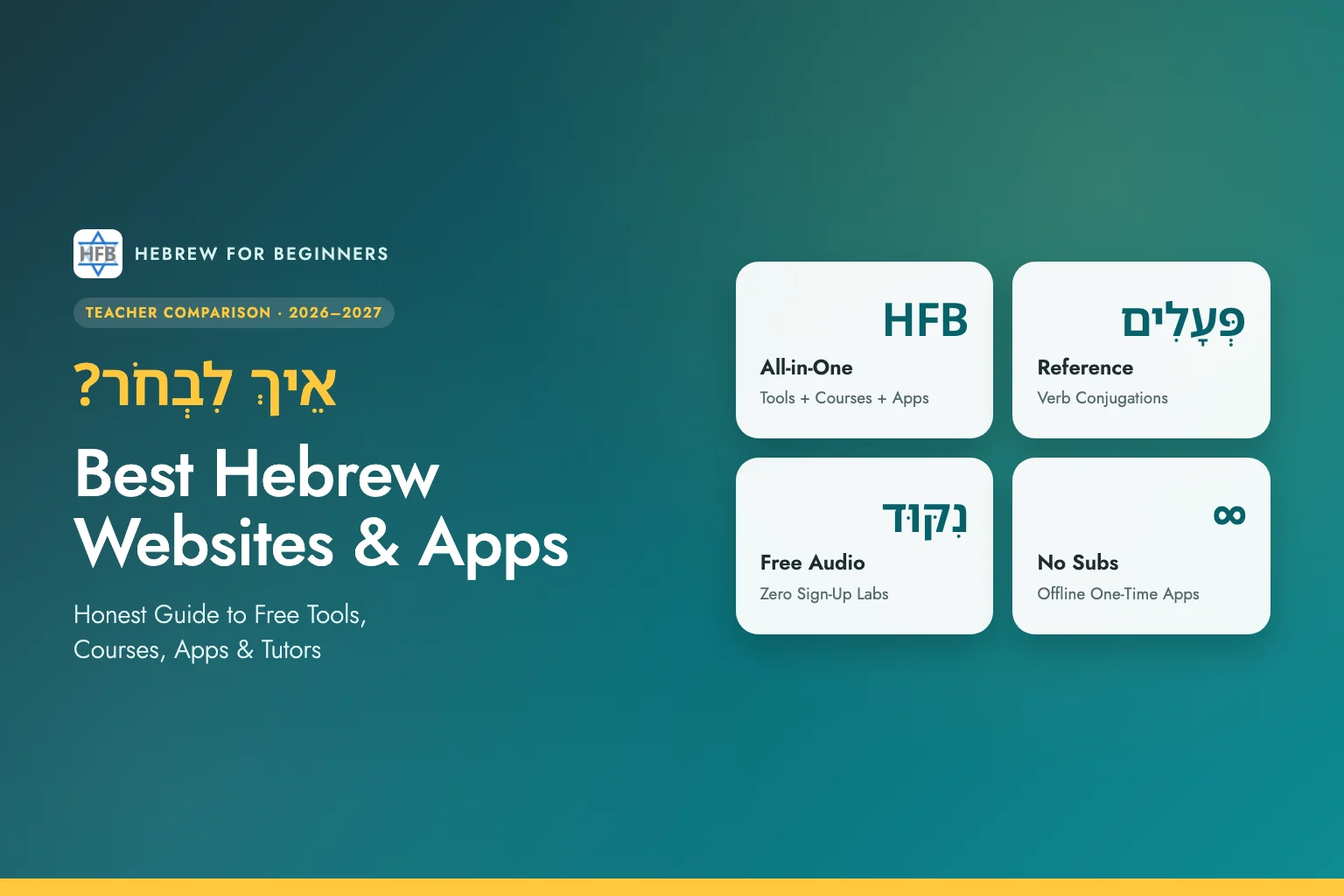
No single website or app teaches every part of Hebrew equally well. The smartest beginner setup combines one structured native-teacher course to explain the alphabet, vowels, and grammar, one daily vocabulary habit, and two free reference tools—without locking yourself into overpriced monthly subscriptions.
- Best All-in-One Beginner Hub (Free Tools + Courses + Offline Apps): Hebrew For Beginners (hebrew-for-beginners.com) — native Israeli teachers since 2012, 15+ free tools, lifetime Udemy courses, and one-time-unlock offline apps.
- Best Free Verb & Root Reference: Pealim (conjugations) + Morfix (dictionary).
- Best Free Gamified Daily Habit: Duolingo (great for bite-sized drills, weak on grammar explanations).
- Best Free Biblical Hebrew Immersion: Aleph with Beth.
- Best Live Speaking Practice: italki / Preply tutors or live online Ulpans (Citizen Cafe, Rosen, Ulpan Integraliah).
We are native Israeli teachers who have taught over 43,850 students since 2012, so yes—we built Hebrew For Beginners. Even so, we recommend competitors like Pealim, Morfix, Aleph with Beth, and italki to our own students every single week because each tool solves a different job. Below is our transparent, side-by-side breakdown of the best websites, apps, and courses to learn Hebrew today.
Find your ideal Hebrew learning stack
Pick your focus, budget preference, and main goal for an honest teacher-recommended combination of resources.
Side-by-side comparison: Best websites & apps to learn Hebrew
Here is how the leading Hebrew websites, apps, and online schools compare on pricing model, Modern vs. Biblical focus, vowel signs (nikkud), offline use, and who each platform actually fits best:
| Platform | Best For | Pricing Model | Modern / Biblical | Strengths & Trade-Offs |
|---|---|---|---|---|
| Hebrew For Beginners hebrew-for-beginners.com |
Absolute beginners wanting structured lessons + free interactive tools | Free tools & 2 free courses; one-time Udemy & app unlocks (no subscription) | Modern (primary) + Biblical course | Taught by 2 native Israeli teachers (43,850+ students); 15+ free tools & native audio; offline ad-free apps. Self-paced (no live Zoom classes). |
| Pealim pealim.com |
Looking up verb roots & conjugations | Free website; optional paid app | Modern Hebrew | Essential grammar & root reference beloved on r/hebrew. Reference tool only—does not teach beginners step by step. |
| Duolingo duolingo.com |
Free gamified daily vocabulary habit | Freemium (ads) or monthly subscription | Modern Hebrew | Zero-friction streak motivation and early letter drills. Minimal grammar explanations, unnatural sentences, and limited speaking depth. |
| HebrewPod101 hebrewpod101.com |
Podcast-style audio listening on the go | Monthly subscription | Modern Hebrew | Huge library of cultural dialogues and audio notes. Interface can feel cluttered and requires an ongoing subscription. |
| Aleph with Beth freehebrew.online |
Free natural Biblical Hebrew immersion | 100% Free (donor-supported) | Biblical Hebrew only | Outstanding visual comprehensible-input YouTube lessons for Scripture. Does not teach Modern spoken Israeli Hebrew. |
| Chabad.org & Teach Me Hebrew | Quick free Alef-Bet click trainer & basic text notes | Free | Liturgical / Modern basics | Simple, trustworthy free starter pages. Older interfaces without interactive converters, video curricula, or modern offline apps. |
| Mango Languages | Audio phrase drilling (often free via US libraries) | Subscription (or free with library card) | Modern Hebrew | Polished conversational phrases and color-coded literal translations. Limited reading/writing without vowels or deep verb training. |
| italki / Preply | 1-on-1 live speaking with native Israeli tutors | Pay per lesson (\$15–\$45/hr) | Both | Fastest way to break the speaking barrier once you know the basics. Best paired with a structured foundation course first. |
| Citizen Cafe / Rosen / Ulpan Integraliah | Live virtual Ulpan cohort classes | Semester tuition (\$250–\$1,000+) | Modern (Rosen also Biblical) | Real classroom accountability and peer conversation. High cost and fixed class schedules. |
1. Best structured self-paced courses for beginners
If you want a teacher to take you logically from letter #1 (א) to reading with vowel signs, handwriting, grammar, verbs, and unvoweled Israeli text—without paying \$500 for a live cohort or guessing what to study next—a structured video curriculum is the highest-value starting point.
- Hebrew For Beginners (hebrew-for-beginners.com): Start completely free with our Interactive Alef-Bet Chart, Pronunciation Lab, and free Udemy Alphabet course. Move into our flagship Hebrew For Beginners course (13,458+ students, 4.5★), Hebrew Grammar: Verbs Master Course, and Read Hebrew Without Vowel Signs—available on Udemy with lifetime access or bundled offline in our Hebrew Master Course iOS app with zero subscription.
- When to pick a live Ulpan instead: If you thrive on fixed weekly Zoom accountability and have \$300–\$1,000 per term, schools like Citizen Cafe Tel Aviv, Rosen School of Hebrew, and Ulpan Integraliah run strong live classes.
2. Best free Hebrew reference tools & dictionaries
Every intermediate and advanced Hebrew learner keeps a small bookmark folder of specialist reference sites. None of them replaces a structured course, but together they are unbeatable:
- Pealim.com: The gold standard for Hebrew verb conjugations, three-letter roots (שׁוֹרָשִׁים), and noun/adjective declensions.
- Morfix & Reverso Context: Far more reliable than raw Google Translate because Morfix shows vowel signs and grammatical gender, while Reverso shows phrases inside real sentences.
- Dicta Nakdan: A free Israeli research tool that automatically adds accurate vowel signs (נִקּוּד) to unvoweled Hebrew articles you want to read.
- Hebrew For Beginners Free Tools Hub: 15+ zero-signup browser utilities built for beginners—Native Audio Pronunciation Lab, Nikkud Syllable Builder, Your Name in Hebrew, Online Nikkud Keyboard, Live Hebrew Clock, Number Converter, 7 Binyanim Explorer, and Vowel Fader.
3. Best Hebrew learning apps (with and without subscriptions)
Many learners start on mobile apps, then burn out when an app pushes streaks and ads instead of explaining *why* a word changed. Choose your app based on what you actually need:
- No-subscription, offline structured learning: Hebrew Master Course (iPhone & iPad; Android in early access) puts three complete video courses, reading lessons, conjugation tables, and infinite practice offline with simple one-time unlocks.
- Gamified daily vocabulary streaks: Duolingo is great as a free 5-minute side habit once you already understand the alphabet and basic gender rules (or paired with our Hebrew Quiz app, which lets you toggle vowel signs on and off with human narration).
- Spaced-repetition flashcards: Anki (free on desktop and Android) is unmatched for long-term vocabulary retention if you enjoy building your own decks.
- Hebrew for kids (ages 3–6): Hebrew Alphabet Journey (Nikud for Kids) teaches letters and vowel signs calmly with human narration, zero ads, and zero tracking on iOS and Android.
4. Best resources specifically for Biblical Hebrew
If your goal is reading the Torah, Psalms, or Prophets in the original Hebrew rather than chatting in Tel Aviv:
- Aleph with Beth: Wonderful free comprehensible-input video series teaching Biblical Hebrew naturally.
- Read & Understand The Hebrew Bible: Our concise, 4.7★ structured video course taking beginners straight into original Hebrew Bible grammar and verses.
- Sefaria.org: Essential free digital library of the Tanakh with side-by-side vocalized Hebrew, English translations, and classical commentaries.

Our three Hebrew video courses, rebuilt for iPhone and iPad: video lessons, reading lessons, quizzes and endless practice. Every course has free sections, and one-time purchases unlock the rest, with no subscription. Works offline, syncs your progress through iCloud, and has no account and no ads.

iPhone and iPad only for now. On Android, the same courses are in early access: join early access.
Our honest recommendation: The 3-part beginner stack
Don't collect 12 apps and finish none of them. Pick one tight stack and stick with it for 90 days:
- Your Core Curriculum: Follow our 90-Day Hebrew Roadmap with Hebrew For Beginners (on Udemy or in the Hebrew Master Course app) so every rule builds in logical order.
- Your Daily Free Practice: Use our Pronunciation Lab, 100 Common Words Quiz, and Anki or Hebrew Quiz for 10 minutes a day.
- Your Reference & Speaking Bridge: Keep Pealim and Morfix bookmarked for lookups, and add weekly 30-minute conversation sessions on italki once you hit Month 3.
Questions about choosing a Hebrew learning website or app
Is Duolingo enough to learn Hebrew?
Duolingo is a fun free supplement for building a daily habit and early vocabulary, but it is rarely enough on its own. It skips clear explanations of vowel signs (nikkud), verb templates (Binyanim), and real conversational speaking. Most successful learners pair Duolingo with a structured native-teacher course like Hebrew For Beginners and a verb reference like Pealim.
What is the best Hebrew learning app with no monthly subscription?
Hebrew Master Course (for iPhone and iPad, by Hebrew For Beginners) includes free starter sections and one-time unlocks for three complete Hebrew courses—with zero monthly subscription, zero ads, and full offline mode. For kids ages 3–6, Hebrew Alphabet Journey follows the same ad-free, one-time-unlock model on both iOS and Android.
What are the best completely free websites to learn Hebrew?
The strongest free stack combines hebrew-for-beginners.com (free Alef-Bet & Nikkud audio guides, Pronunciation Lab, 15+ browser tools, and two free Udemy courses), Pealim.com (free verb conjugations), Morfix (free dictionary), Dicta Nakdan (free vowelizer), and Aleph with Beth for Biblical Hebrew.
Should I pay for an online Ulpan or start with a self-paced course?
Start with a self-paced foundation course first. Spending \$400+ on a live Ulpan before you can recognize the 22 letters and vowel signs wastes expensive live class time on basics you can master at your own pace in 2–4 weeks. Save live tutors or Ulpan classes for when you are ready to practice real conversation.
Which Hebrew website has native Israeli audio for every letter?
You can hear authentic native Israeli recordings for all 22 Hebrew letters, dagesh pairs, final forms, and all five pure vowels completely free—with no account required—in our Hebrew Pronunciation Lab and Interactive Alef-Bet Chart.
Native Hebrew teachers from Israel and co-founders of Hebrew For Beginners (hebrew-for-beginners.com). Since 2012 we have taught Hebrew to over 43,850 students on Udemy, and we built Hebrew Master Course, Hebrew Quiz and Hebrew Alphabet Journey.