How Long Does It Take to Learn Hebrew? Data & Honest Guide for English Speakers
From reading the alphabet in 2 weeks to holding conversations in 3–6 months: realistic timelines backed by FSI benchmarks and 14 years of teaching English speakers.
 By Guy Ben-Moshe & Itzchak PinhasovNative Hebrew teachers from Israel · Teaching since 2012
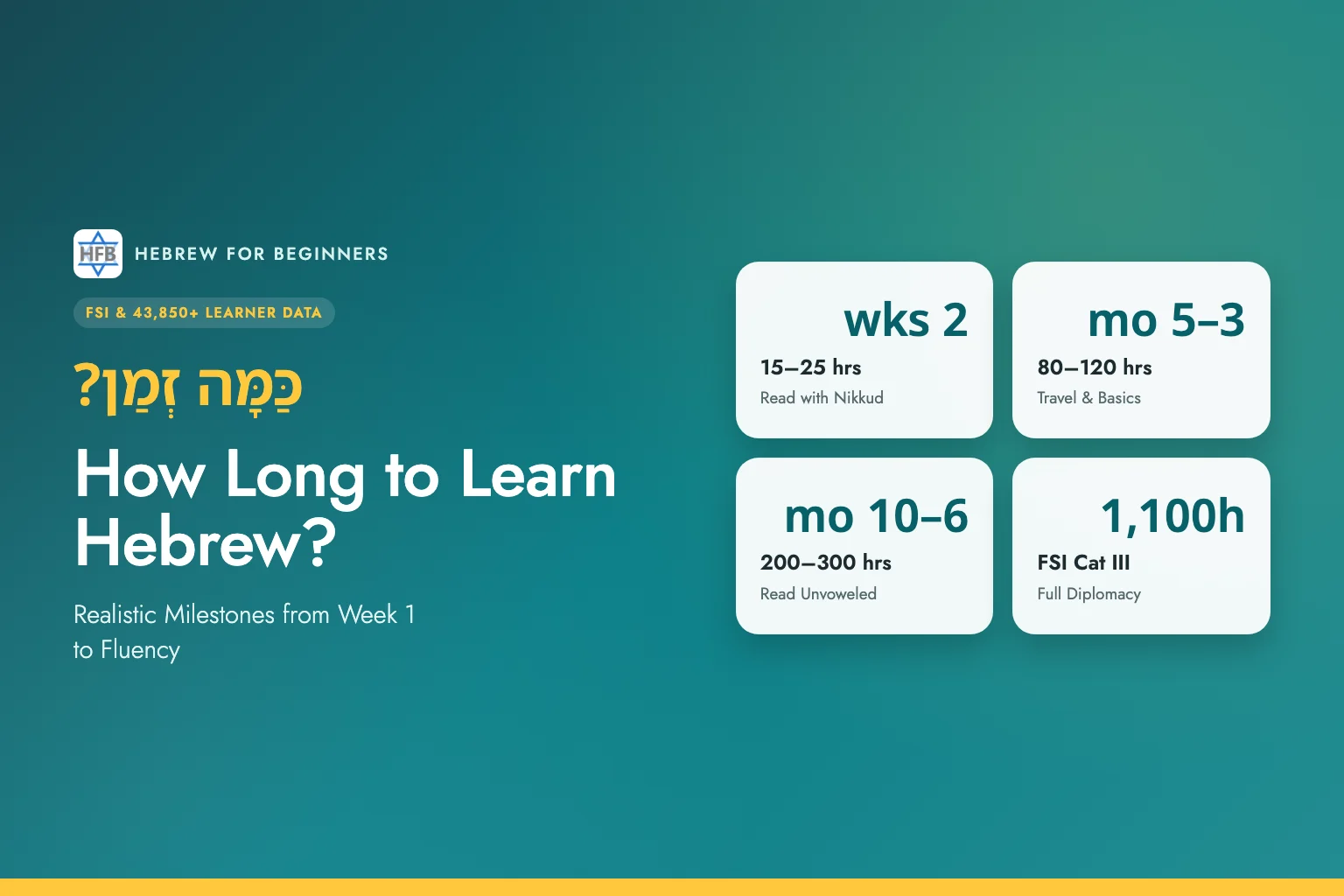
The U.S. Foreign Service Institute (FSI) estimates 1,100 classroom hours (44 weeks full-time) for an English speaker to reach full professional fluency in Hebrew—yet based on 14 years of teaching 43,850+ students, most beginners learn to read vocalized Hebrew in 2–4 weeks and hold everyday travel and social conversations within 3–6 months of steady daily study.
- Read the Alef-Bet & Vowel Signs: 15–25 hours (2–4 weeks at 30 min/day)
- Travel & Everyday Survival Hebrew: 80–120 hours (3–5 months at 45 min/day)
- Read Israeli Signs & Simple Text Without Vowels: 200–300 hours (6–10 months)
- Comfortable Conversational Fluency (B1–B2): 500–750 hours (1–2 years self-study)
- Professional Diplomacy Fluency (FSI Category III): ~1,100 hours
Whenever English speakers ask "Is Hebrew hard to learn?", they see the intimidating "1,100 hours" FSI number and assume they won't be able to say a sentence for two years. That figure measures elite diplomatic fluency (reading legal briefs and debating policy in Hebrew)—not ordering coffee in Tel Aviv, reading street signs, or chatting with family. Estimate your personal timeline below.
Hebrew Learning Time Estimator
Pick your target milestone and weekly study hours to see a realistic estimate based on FSI & student milestone data.
Hebrew learning milestones: Hours vs. real-world ability
Drawing on benchmarks from the U.S. Foreign Service Institute (FSI) and 14 years of learner progress across our 43,851 Udemy students (2012–2026), here is what each stage actually takes for a native English speaker:
| Milestone | Est. Study Hours | At 30 min/day | At 1 hr/day | What You Can Actually Do |
|---|---|---|---|---|
| 1. Alef-Bet Letters | 5–10 hrs | 1–2 weeks | 1 week | Recognize all 22 letters, 5 final forms, and sounds |
| 2. Reading With Nikkud | 15–25 hrs | 3–5 weeks | 2–3 weeks | Sound out vocalized Hebrew books, prayers, and study texts |
| 3. Travel & Core Basics (A1) | 80–120 hrs | 5–8 months | 3–4 months | Introduce yourself, order food, shop, ask directions, tell time |
| 4. Reading Without Vowels (A2) | 200–300 hrs | 12–16 months | 7–10 months | Read Israeli menus, signs, WhatsApp texts, and simplified news |
| 5. Conversational Fluency (B1–B2) | 550–750 hrs | ~3 years | 1.5–2 years | Follow Israeli TV/podcasts, chat naturally across past/present/future |
| 6. Professional Fluency (FSI Cat III) | ~1,100 hrs | ~5+ years | ~3 years | Read complex newspapers, literature, and work professionally in Hebrew |
4 reasons Hebrew is actually EASIER than English speakers expect
Hebrew sits in FSI Category III (1,100 hours, "hard languages with significant linguistic differences from English" — formerly labeled Category IV on the older 5-tier scale) alongside Russian, Polish, and Greek—still one full tier easier than Category IV ("super-hard") languages like Arabic, Mandarin, Japanese, and Korean (2,200 hours). Four built-in features make Hebrew far friendlier than its reputation:
- Only 22 letters and 5 pure vowels: Unlike Chinese characters or Arabic's four context-connected letter shapes, Hebrew letters stand cleanly apart, have no uppercase/lowercase split, and use just five pure vowel sounds (A, E, I, O, U)—compared to ~15 shifting vowels in English.
- Only 2 unfamiliar consonant sounds: Only Chet (ח) and Israeli Resh (ר) don't exist in standard English. Practice both in 5 minutes using our Native Audio Pronunciation Lab.
- Logical three-letter root families: Once you learn one root like כ-ת-ב (write), you unlock an entire cluster of related words instantly (כּוֹתֵב writing, מִכְתָּב letter, כְּתֹבֶת address, כַּתָּבָה article).
- No present-tense "to be" and only 3 main tenses: Hebrew skips "am/is/are" in the present tense, drops "a/an", and has no complex continuous or perfect tense ladders.
4 parts of Hebrew that genuinely take practice
Being honest about the real speed bumps helps you plan around them instead of feeling discouraged:
- Reading without vowel signs (נִקּוּד): Everyday Israeli writing omits vowel dots, so beginners must gradually train pattern recognition using our 7 Tips for Reading Without Vowels.
- Grammatical gender everywhere: Every noun—and every adjective, number, and verb tied to it—is masculine or feminine (even "you" has four forms: אַתָּה, אַתְּ, אַתֶּם, אַתֶּן).
- The 7 verb patterns (Binyanim): Verbs shift form across gender, number, person, and tense, though all verbs fit cleanly inside 7 structured Binyanim templates.
- Unfamiliar Semitic vocabulary: Unlike Spanish or French, Hebrew shares fewer everyday cognates with English—meaning consistent daily vocabulary exposure (like our 100 Most Common Hebrew Words) is essential.
Is Modern Hebrew or Biblical Hebrew faster to learn?
If your goal is reading basic verses of Genesis aloud with a lexicon, Biblical Hebrew has a smaller core vocabulary (~8,000 total words in the entire Hebrew Bible, with the top ~500 words covering over 80% of occurrences). However, Modern Hebrew gives you vastly more audio, Israeli TV, podcasts, and native speakers to practice with every day. Compare both tracks in Biblical Hebrew vs Modern Hebrew.
5 proven ways to cut your Hebrew learning time in half
- Drop transliteration by Day 14: Students who learn the Alef-Bet and Nikkud in Weeks 1–2 progress twice as fast in Months 2–6.
- Follow one structured curriculum instead of random clips: Use our 90-Day Beginner Roadmap alongside a sequential course like Hebrew For Beginners.
- Study 20–30 minutes daily rather than cramming weekends: Daily spaced recall locks in roots and right-to-left eye tracking far faster.
- Say every word out loud from Day 1: Shadow native audio recordings so your mouth builds muscle memory for final-syllable stress.
- Pair structured lessons with offline micro-practice: Turn idle commute minutes into 5-minute drills using Hebrew Master Course or Hebrew Quiz.
 Hebrew For Beginners
Learn to speak, read and write Hebrew from scratch with two native Hebrew teachers.
See syllabus & enroll →Questions about Hebrew difficulty and learning time
Is Hebrew hard to learn for English speakers?
Hebrew is moderately challenging—classified as FSI Category III (1,100 classroom hours; easier than Arabic, Mandarin, or Japanese, harder than Spanish or French). The right-to-left alphabet and gendered verbs take initial adjustment, but Hebrew's five pure vowels, regular three-letter roots, and 22-letter script make it much more logical than most beginners fear.
How many hours does it take to become fluent in Hebrew?
The U.S. Foreign Service Institute estimates around 1,100 study hours for full professional fluency. Most self-taught learners reach comfortable everyday conversational fluency in 550–750 hours, and travel/basic conversation in 80–120 hours.
Can I learn to read Hebrew in one month?
Yes! Nearly every committed beginner learns to read vocalized Hebrew (with nikkud) within 2 to 4 weeks at 20–30 minutes a day. Reading everyday unvoweled Israeli text typically takes 4–8 months once you have built a solid core vocabulary.
Is Hebrew easier to learn than Arabic?
For English speakers, yes—significantly faster. FSI estimates 1,100 hours for Hebrew versus 2,200 hours for Arabic. Hebrew letters do not change into four connected contextual shapes, and Modern Israeli Hebrew does not split into widely different regional spoken dialects vs. Modern Standard Arabic. See Hebrew vs Arabic: Similarities and Differences.
Can you learn Hebrew in 3 months?
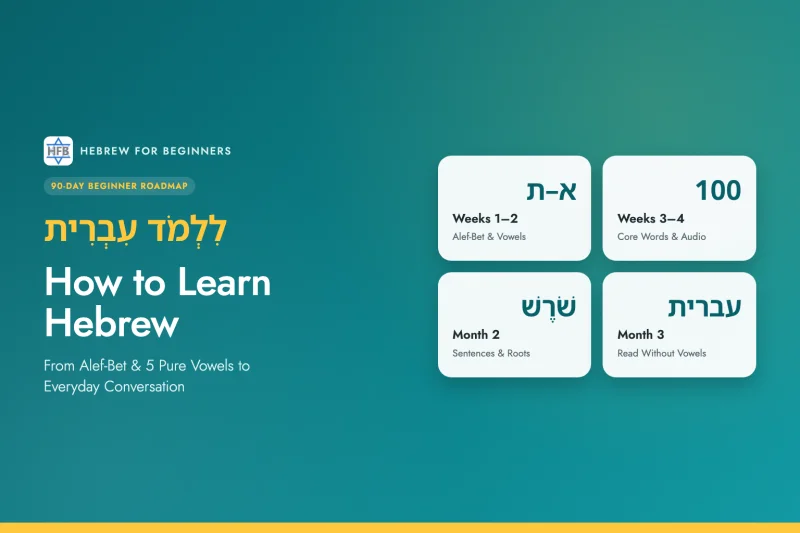
In 3 months (30–60 minutes a day), you will not reach native fluency, but you can realistically master the alphabet, vowel signs, cursive handwriting, 300–500 everyday words, present-tense sentences, and basic travel conversations—following our 90-Day Hebrew Roadmap.
Native Hebrew teachers from Israel and co-founders of Hebrew For Beginners (hebrew-for-beginners.com). Since 2012 we have taught Hebrew to over 43,850 students on Udemy, and we built Hebrew Master Course, Hebrew Quiz and Hebrew Alphabet Journey.