How to Learn Hebrew from Scratch: The Complete 90-Day Beginner Roadmap
From your very first Hebrew letter to holding everyday conversations—the exact 4-stage beginner sequence used by 43,850+ students since 2012, plus a personalized study plan builder.
 By Guy Ben-Moshe & Itzchak PinhasovNative Hebrew teachers from Israel · Teaching since 2012
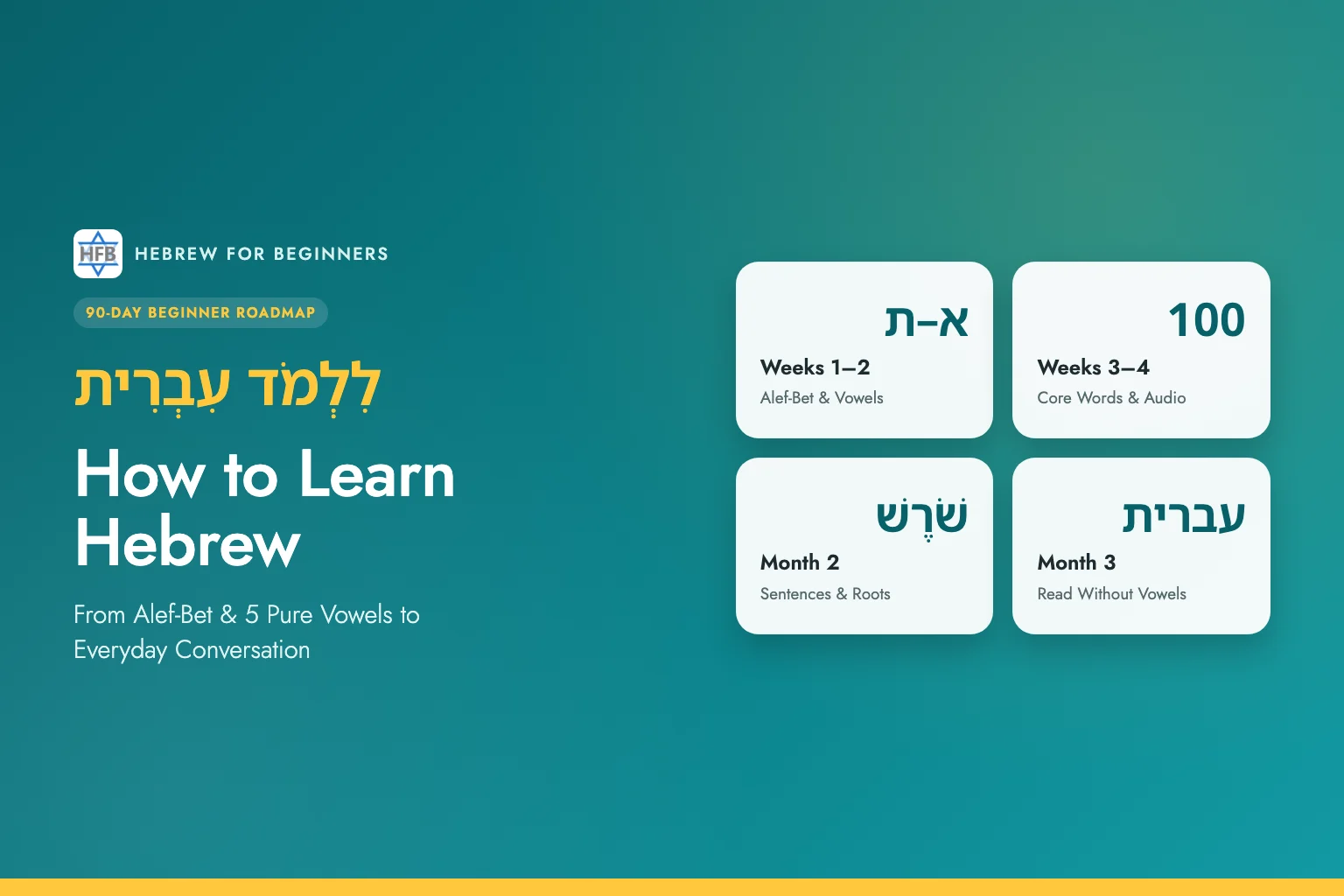
The fastest way to learn Hebrew from scratch is to spend your first two weeks mastering the 22-letter Alef-Bet and five pure vowel sounds (nikkud)—never staying trapped in English transliteration—then layer on 300 high-frequency words, gendered nouns, present-tense sentences, and finally the seven verb patterns (Binyanim).
- Weeks 1–2 (Script & Sounds): Learn the 22 letters, 5 final forms, and 5 pure vowels (נִקּוּד) with native Israeli audio.
- Weeks 3–4 (First 200 Words): Build everyday survival phrases, greetings, numbers, and masculine/feminine agreement.
- Months 2–3 (Sentences & Grammar): Master present-tense verbs, prefixes (ב, ל, מ, ה, ו, ש, כ), and past/future roots.
- Month 3+ (Real Israeli Hebrew): Transition to reading without vowel signs, listening to Israeli audio, and speaking out loud daily.
Since 2012, we (Guy Ben-Moshe and Itzchak Pinhasov) have taught Hebrew to over 43,850 students worldwide through our courses, apps, and free browser tools. Almost every learner who quits early makes the same mistake: jumping straight into random flashcards without learning how Hebrew actually reads and builds words. Follow the roadmap below—or customize your exact schedule with our interactive planner.
Build your personalized 90-day Hebrew study plan
Pick your goal, current level, and daily time to get a week-by-week plan using free tools and structured lessons.
Step 0: Choose Modern Hebrew or Biblical Hebrew first
Before opening a single lesson, decide whether your goal is Modern Israeli Hebrew (spoken daily by over 9 million people in Israel for conversation, travel, news, and family) or Biblical Hebrew (the classical language of the Torah and Hebrew Bible). Both share the exact same 22-letter alphabet and three-letter root system, so starting with the script serves either path—but their grammar, word order, and vocabulary diverge quickly.
Not sure which fits you? Read our side-by-side breakdown in Biblical Hebrew vs Modern Hebrew: What's the Difference?. If you want both, start with Modern Hebrew first: native Israeli children read Genesis aloud effortlessly because the shared roots carry straight over.
Weeks 1–2: Crack the Hebrew alphabet and five pure vowels
Spend your first 10 to 14 days (just 20 minutes a day) learning to read real Hebrew script with vowel signs (נִקּוּד, nikkud). English transliteration is inconsistent—one word like חֲנוּכָּה gets spelled a dozen ways in English—and slows down every learner who relies on it too long.
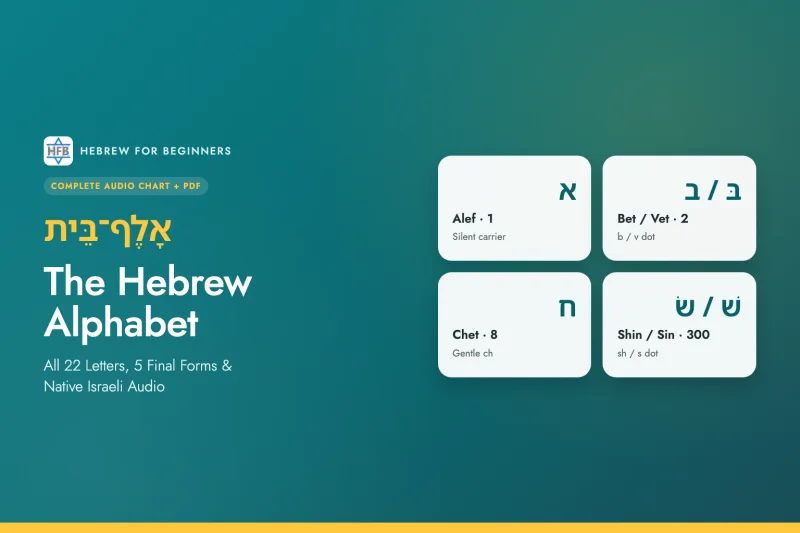
- Start with our free interactive guide: Use The Hebrew Alphabet (Alef-Bet) chart with native Israeli audio and print the 1-page reference sheet.
- Master the 5 pure vowels: Unlike English's ~15 shifting vowels, Modern Israeli Hebrew uses just five pure vowel sounds (A, E, I, O, U). Practice every consonant+vowel combination in our Hebrew Vowels (Nikkud) guide.
- Fix pronunciation habits on Day 1: Only two Hebrew consonant sounds—Chet (ח) and Israeli Resh (ר)—do not exist in English. Listen and repeat with our free Hebrew Pronunciation Lab.
- Watch a structured video walkthrough: Enroll in our 100% free 1-hour course Know The Hebrew Alphabet (21,620+ students, 4.7★).
Weeks 3–4: Learn 200 high-frequency words and survival phrases
Once you can sound out vocalized Hebrew slowly, immediately attach meaning to the words you hear most often in everyday Israel. A few hundred core words account for the majority of daily conversation and give you real reading momentum.
- Master the top 100 words first: Study and quiz yourself with our 100 Most Common Hebrew Words interactive list (and toggle vowel signs off once a word looks familiar).
- Learn counting and telling time: Numbers introduce Hebrew grammatical gender immediately. Practice with our Hebrew Numbers converter and Live Hebrew Clock.
- Start typing Hebrew early: Writing reinforces reading memory faster than passive scrolling. Set up a Hebrew layout on your phone and computer using How to Type in Hebrew or type directly in our Online Hebrew Keyboard.
Months 2–3: Build real sentences, gender agreement, and verb roots
In Month 2, shift from isolated vocabulary to constructing real sentences. Hebrew grammar is surprisingly logical once you know the nine places where it parts ways with English—especially grammatical gender, the definite direct-object marker אֶת (et), and glued one-letter prefixes.
- Learn the 9 key structural shifts: Read Hebrew vs English: 9 Main Differences so you stop translating English sentences word for word.
- Unlock the Hebrew root engine: Almost every Hebrew verb is built from a three-letter root (שֹׁרֶשׁ, shoresh) plugged into one of just seven verb patterns (בִּנְיָנִים, Binyanim). Explore how one root transforms in Hebrew Verbs & the 7 Binyanim Explained Simply.
- Follow one complete step-by-step course: Rather than stitching random YouTube clips together, follow our structured flagship Hebrew For Beginners course (107 lectures, 6.5 hours, lifetime access) or practice offline in our Hebrew Master Course iOS app.
Month 3 and beyond: Read without vowel signs and speak daily
Everyday Israeli newspapers, books, menus, WhatsApp messages, and street signs leave out the vowel signs (נִקּוּד) completely. That sounds intimidating until you learn how Israelis actually read unvoweled text—by spotting vowel helper letters (א, ה, ו, י), glued prefixes, and recurring word templates.
- Take off the training wheels gradually: Read How to Read Hebrew Without Vowel Signs: 7 Tips and train daily with our Interactive Vowel Fader.
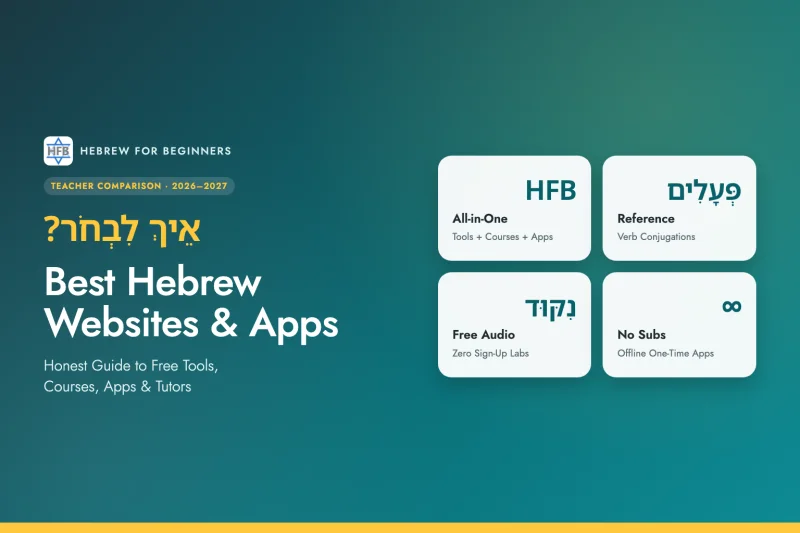
- Pair with the right companion tools: Bookmark Pealim for verb conjugation lookups and Morfix for dictionary definitions, and check our full Best Websites, Apps & Courses to Learn Hebrew comparison.
- Speak out loud every day: Shadow native dialogues in our free Conversational Hebrew: Introduction course or practice 20-minute tutor sessions once you can form basic sentences.
The 90-Day Hebrew Study Schedule (At a Glance)
Consistency beats marathon weekend sessions every single time. Based on data from our students and benchmarks from the U.S. Foreign Service Institute (FSI), just 25–30 minutes a day over 90 days (~40–45 hours total) takes a complete beginner from zero to reading vocalized Hebrew, holding simple everyday exchanges, and recognizing core roots.
| Stage | Focus | Milestone You Reach | Free Tool / Course |
|---|---|---|---|
| Days 1–14 | Alef-Bet, 5 pure vowels, Chet/Resh sounds | Sound out any vocalized Hebrew word aloud | Alef-Bet Chart · Pronunciation Lab |
| Days 15–30 | Top 100 words, greetings, numbers, gender | Introduce yourself, count, tell time, read signs | 100 Words Quiz · Free Alphabet Course |
| Days 31–60 | Present tense, prefixes, אֶת, handwriting | Build original everyday sentences & questions | Hebrew For Beginners · Verb Builder |
| Days 61–90 | Past/future roots, 7 Binyanim, fading nikkud | Read beginner Israeli text & hold short chats | 7 Binyanim Explorer · Vowel Fader |
 Hebrew For Beginners
Learn to speak, read and write Hebrew from scratch with two native Hebrew teachers.
See syllabus & enroll →A realistic 20-minute daily Hebrew routine
If you are studying around a job or family, keep your daily routine frictionless so you never miss two days in a row:
- 5 minutes — Listening & pronunciation warm-up: Tap 5 tricky letters or vowel pairs in the Pronunciation Lab or repeat short phrases aloud.
- 10 minutes — One structured lesson: Watch one video lesson in Hebrew For Beginners or Hebrew Master Course and write 3 example words by hand.
- 5 minutes — Active recall quiz: Drill 10 words with vowel signs toggled off in our 100 Common Words Quiz or Hebrew Quiz mobile app.
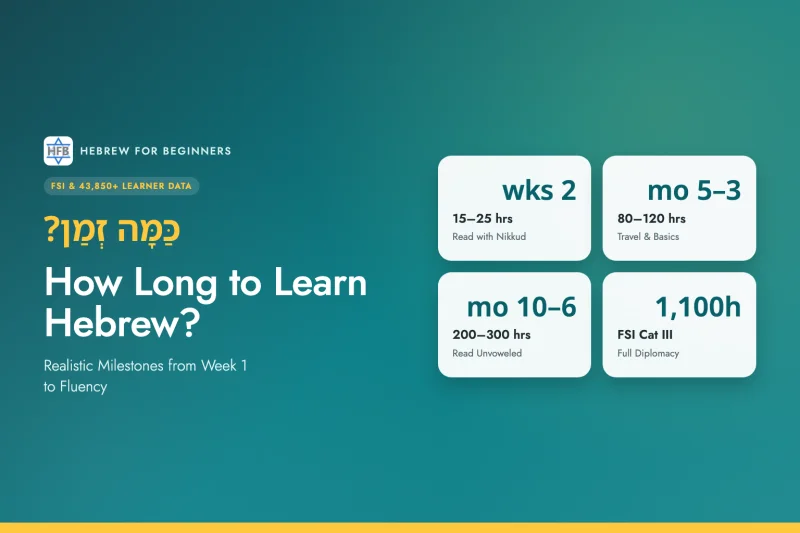
Want to know exactly how many hours each milestone takes? See our data-backed guide How Long Does It Take to Learn Hebrew?.
Frequently asked questions about learning Hebrew
What is the best way to start learning Hebrew from scratch?
Start by learning the 22 letters of the Hebrew alphabet (Alef-Bet) and the five Modern Israeli vowel sounds (nikkud) with native audio during your first two weeks. Avoid relying on English transliteration, then build a core bank of 200–300 everyday words, basic present-tense sentences, and three-letter verb roots.
Can I learn Hebrew online for free?
Yes. You can start completely free on hebrew-for-beginners.com using our 15+ interactive browser tools (Pronunciation Lab, Alef-Bet & Nikkud trainers, 100 Common Words quiz, Online Keyboard, 7 Binyanim Explorer) and our two free Udemy video courses: Know The Hebrew Alphabet and Conversational Hebrew: Introduction.
Should I learn to read Hebrew before speaking it?
Learn both together starting in Week 1, with reading as your anchor. Because Hebrew has only 22 letters and five pure vowel sounds, most beginners can sound out vocalized Hebrew within two weeks—which makes pronunciation and vocabulary far easier to remember than guessing English spellings.
Is it possible to teach yourself Hebrew without living in Israel?
Absolutely. Thousands of our students have learned to read, understand, and speak Hebrew from abroad by combining a structured native-teacher video curriculum, daily native audio shadowing, spaced-repetition vocabulary practice, and short online conversation practice once they reach Month 3.
What is the best website to learn Hebrew for beginners?
For absolute beginners, look for a platform that combines structured native-teacher lessons with free interactive reading and audio tools—like hebrew-for-beginners.com—and pair it with specialized reference tools such as Pealim (verb conjugations) and Morfix (dictionary) as you advance. See our full honest comparison in Best Websites & Apps to Learn Hebrew.
How many minutes a day do I need to learn Hebrew?
Twenty to thirty focused minutes every day beats a three-hour Sunday cram session. At 30 minutes per day, you can master reading with vowel signs in 2–4 weeks and hold everyday travel and beginner conversations within 3–4 months.
Native Hebrew teachers from Israel and co-founders of Hebrew For Beginners (hebrew-for-beginners.com). Since 2012 we have taught Hebrew to over 43,850 students on Udemy, and we built Hebrew Master Course, Hebrew Quiz and Hebrew Alphabet Journey.