Hebrew Vowels (Nikkud) Explained: Complete Chart, Audio & Reading Guide
Over a dozen traditional dots and dashes boil down to just five crisp vowel sounds in Modern Israel. Combine any consonant and vowel sign below and hear it spoken aloud.
 By Guy Ben-Moshe & Itzchak PinhasovNative Hebrew teachers from Israel · Teaching since 2012
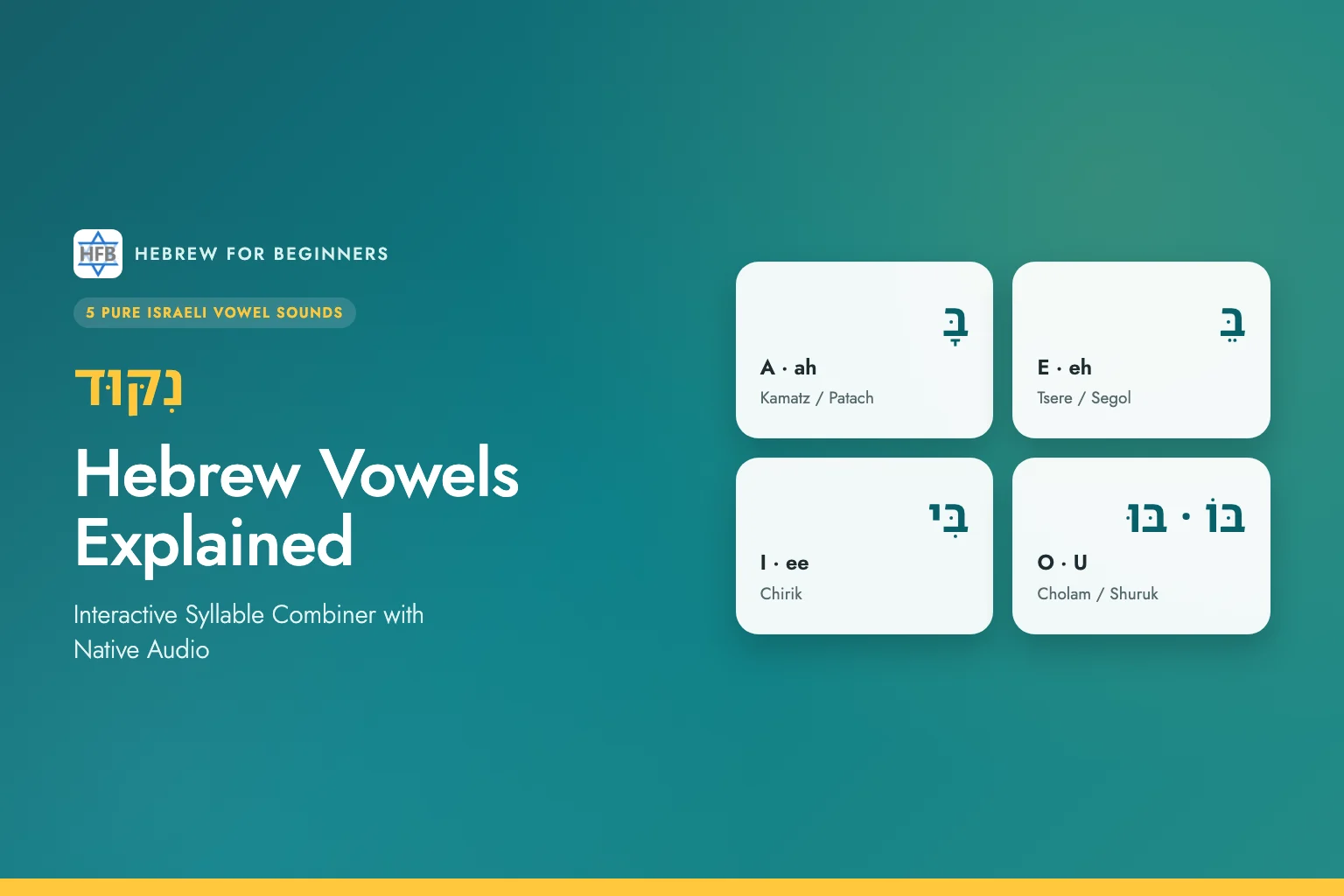
Hebrew vowel signs (נִקּוּד, nikkud) look intimidating at first because there are over a dozen tiny dots and dashes—yet Modern Israeli Hebrew uses only five pure vowel sounds: A, E, I, O, and U. Once you group the symbols by those five sounds, you can read vocalized Hebrew within a weekend.
- A ("ah" as in father): Kamatz (אָ) and Patach (אַ)
- E ("eh" as in bed): Tsere (אֵ), Segol (אֶ), and vocal Shva (אְ)
- I ("ee" as in machine): Chirik (אִ / אִי)
- O ("oh" as in more): Cholam (אֹ / אוֹ) and rare Kamatz Katan (כָּל)
- U ("oo" as in rule): Kubutz (אֻ) and Shuruk (אוּ)
Build any Hebrew syllable below and tap to hear real native Israeli speaker recordings—just like inside our Hebrew Alphabet Journey and Hebrew Master Course apps.
Interactive Nikkud Vowel Syllable Builder (With Audio)
Pick a consonant, then tap any vowel sign to combine them and hear the exact Israeli pronunciation.
Complete Hebrew vowels (Nikkud) chart grouped by sound
Ancient scholars in Tiberias created more than a dozen vowel marks around the 7th–10th centuries CE to preserve fine Biblical distinctions in vowel length. In everyday Modern Israeli Hebrew, those length differences merged into five crisp, pure vowels (no English -y or -w glides). Tap any sound below to hear it:
| Vowel Sound | Nikkud Name & Shape | Hear Sound | Example Words |
|---|---|---|---|
| A (ah) | Kamatz (בָּ) & Patach (בַּ) & Chataf-Patach (אֲ) Little T or flat dash underneath |
אַבָּא (A-ba, dad), דָּג (dag, fish) | |
| E (eh) | Tsere (בֵּ), Segol (בֶּ) & Chataf-Segol (אֱ) 2 dots across or 3-dot triangle underneath |
סֵפֶר (SE-fer, book), יֶלֶד (YE-led, boy) | |
| I (ee) | Chirik (בִּ) & Chirik Male (בִּי) Single dot underneath (often followed by י) |
אִמָּא (I-ma, mom), שִׁיר (shir, song) | |
| O (oh) | Cholam (בֹּ) & Cholam Male (בּוֹ) & Chataf-Kamatz (אֳ) Dot above top-left corner or on top of ו |
שָׁלוֹם (sha-LOM, peace), בֹּקֶר (BO-ker, morning) | |
| U (oo) | Shuruk (בּוּ) & Kubutz (בֻּ) Dot inside ו, or 3 diagonal dots underneath |
שֻׁלְחָן (shul-CHAN, table), סוּס (sus, horse) | |
| Silent / short E | Shva (בְּ) Two vertical dots underneath |
שְׁלוֹם (shlom) · סִפְרִיָּה (sif-ri-YA, library) |
How to read a letter + vowel sign together
Always read the consonant first, then the vowel sign attached to it—moving across the word from right to left. Think of every letter and its nikkud as one tiny syllable block:
Three nikkud quirks beginners should know
Ninety-five percent of Hebrew reading follows the clean 5-vowel chart above. Knowing these three small exceptions right away saves months of confusion:
- Shva (ְ) — stop vs. quick "eh": When Shva sits at the start of a word (like בְּבַקָּשָׁה, be-va-ka-SHA, "please"), Israelis pronounce a very short e or blend the consonants smoothly (zman זְמַן). In the middle or end of a syllable (like מַלְכָּה, mal-KA, "queen"), Shva simply cuts off the consonant with no vowel after it.
- Kamatz Katan (the "O" Kamatz): In a tiny handful of common words, the T-shaped Kamatz (ָ) is pronounced "o" instead of "a"—most famously in כָּל (kol, "all / every"), חָכְמָה (choch-MA, "wisdom"), and צָהֳרַיִם (tzo-ho-RA-yim, "noon").
- Patach Gnuva (the "stolen a"): When ח or ע appears at the very end of a word with a Patach (ַ) underneath, pronounce the a before the consonant: רוּחַ is RU-ach (wind/spirit) and תַּפּוּחַ is ta-PU-ach (apple).
Where do Israelis still use nikkud—and when does it disappear?
In Israel, full vowel signs appear in children's books, poetry, prayer books (siddurim), the Hebrew Bible, learner textbooks, and dictionaries. Everyday Israeli newspapers, novels, street signs, websites, and text messages omit nikkud completely.
Do not skip nikkud as a beginner: learning with vowel signs for your first 2–3 months builds accurate pronunciation and word recognition in your brain. Once you know ~200–300 common words, graduate cleanly using our 7 Tips for Reading Hebrew Without Vowel Signs and Interactive Vowel Fader.
 Hebrew For Beginners
Learn to speak, read and write Hebrew from scratch with two native Hebrew teachers.
See syllabus & enroll →
Drag a vowel sign onto a letter and it comes alive with sound, color and motion. Three calm games, professional human narration, no ads and no tracking. Works offline.

Questions about Hebrew vowels (Nikkud)
How many vowel sounds does Modern Hebrew have?
Modern Israeli Hebrew has exactly five pure vowel sounds: A (ah), E (eh), I (ee), O (oh), and U (oo)—just like Spanish or Italian. Even though there are more than a dozen traditional nikkud symbols, they all map onto those five sounds.
Why are there multiple Hebrew vowel signs for the same sound?
Ancient Tiberian Hebrew distinguished long vowels (like Kamatz and Tsere) from short vowels (like Patach and Segol). Over centuries, Modern Israeli speech merged those lengths into identical pure sounds while keeping the traditional spellings.
Do I really need to learn nikkud if Israelis don't use it in newspapers?
Yes—just as English speakers learn to read with clear phonics before skimming fast shorthand. Learning nikkud takes only a few days and trains your ear to the right vowels and word patterns so reading unvoweled Hebrew later feels natural instead of random guessing.
How can I type Hebrew vowel signs (nikkud) online?
You can type full Hebrew with nikkud immediately in any browser with zero setup using our free Online Hebrew Keyboard with Vowel Signs, or install a native layout using our Hebrew Keyboard Setup Guide.
What is the difference between Ashkenazi and Israeli nikkud pronunciation?
Standard Israeli Hebrew (based mostly on Sephardi vowel traditions) pronounces Kamatz as a (Amen, Shabbat), whereas traditional Ashkenazi liturgical pronunciation reads Kamatz as o/aw (Omein) and Tsere as ey.
Native Hebrew teachers from Israel and co-founders of Hebrew For Beginners (hebrew-for-beginners.com). Since 2012 we have taught Hebrew to over 43,850 students on Udemy, and we built Hebrew Master Course, Hebrew Quiz and Hebrew Alphabet Journey.