Hebrew vs Arabic: Similarities and Differences
Shalom and salaam are no coincidence. Hebrew and Arabic share roots, grammar and hundreds of words, yet look and sound different.
 By Guy & ItzikNative Hebrew teachers from Israel
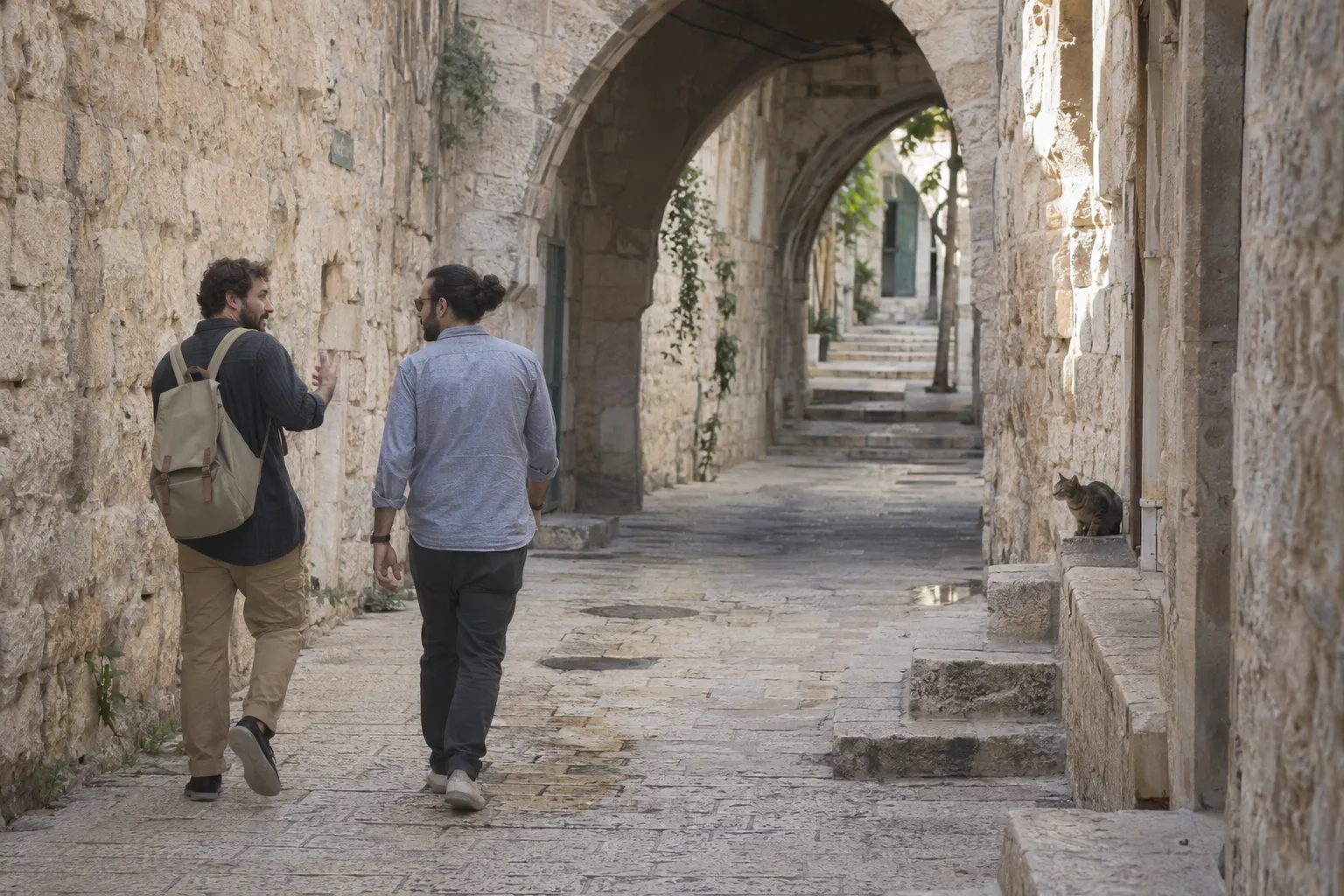
שָׁלוֹם (shalom) and سلام (salaam). יוֹם (yom) and يوم (yawm). Hebrew and Arabic are cousins from the same family, the Semitic languages, and it shows. They share roots, grammar and hundreds of words, yet they look and sound quite different.
If you speak one, the other will feel strangely familiar. Here is what they have in common and where they part ways.
One family: the Semitic languages
Hebrew, Arabic and Aramaic all descend from a common ancestor spoken in the Middle East thousands of years ago, the way Spanish, French and Italian descend from Latin. Their writing systems also share an ancestor, the ancient Phoenician alphabet. That is why the order of the first letters still lines up: Hebrew א ב ג ד (alef, bet, gimel, dalet), and the old order of the Arabic letters, أ ب ج د (alif, ba, jim, dal).
Words they share
Because both languages build words from the same ancient roots, many everyday words are close relatives. Compare:
Hebrew and Arabic word pairs
Notice the regular sound shifts: Hebrew sh often matches Arabic s (shalom, salaam), and Hebrew o often matches Arabic a (rosh, ra's).
What they have in common
- Right to left, consonants first. Both scripts are written from right to left and mainly show consonants. Short vowels are optional marks: נִקּוּד (nikkud) in Hebrew, harakat in Arabic, and adults read both languages without them.
- Roots and patterns. Words grow from three-letter roots poured into patterns. The root K-T-B, "writing", gives Hebrew כָּתַב (he wrote), מִכְתָּב (letter) and כְּתֹבֶת (address), and Arabic kataba (he wrote), maktab (office) and kitab (book). Hebrew verbs come in seven patterns, the בִּנְיָנִים (binyanim); Arabic has about ten in regular use.
- Two genders. Every noun is masculine or feminine, and verbs change for "you" depending on whether you speak to a man or a woman.
- "The" is a prefix. Hebrew הַ (ha-) and Arabic al- are glued to the front of the word: הַבַּיִת (ha-bayit) and al-bayt, the house.
Where Hebrew and Arabic differ
The script
Hebrew has 22 letters, five with a special final form. Printed Hebrew letters stand apart from each other. Arabic has 28 letters, and it is always cursive: letters join to their neighbors and most have up to four shapes, depending on whether they stand alone or come at the start, middle or end of a word.
The sounds
Arabic kept more of the ancient Semitic sounds: deep throat sounds and "emphatic" consonants pronounced with the back of the tongue. In Modern Hebrew many of these merged. Most Israelis pronounce ע like א and ח like כ, so Hebrew has fewer sounds that are hard for English speakers.
The grammar
Arabic grammar keeps several features that Hebrew lost or simplified. Literary Arabic has case endings on nouns, and a full "dual" form for exactly two of something in nouns, verbs and pronouns. Hebrew has no cases, and its dual survives only in a handful of nouns: יוֹמַיִם (yomayim, two days), עֵינַיִם (enayim, eyes).
One language or many?
Arabic speakers live with two layers: Modern Standard Arabic for writing, news and formal speech, and the local spoken dialect, which can differ a lot from Morocco to Iraq. Modern Hebrew is much more uniform: what you hear on the street is close to what you read in the newspaper.
History and size
Arabic has been spoken without a break for well over a thousand years and is the main language of more than twenty countries, with hundreds of millions of speakers. Hebrew stopped being an everyday spoken language in ancient times, lived on as a language of writing and prayer, and was revived as a mother tongue only in the late 19th and 20th centuries. Today about nine million people speak it. (Read more about that journey in Biblical Hebrew vs Modern Hebrew.)
Does knowing Arabic help you learn Hebrew?
A lot. If you speak Arabic, Hebrew roots, patterns and many words will feel familiar from day one, and the hardest part will simply be the new alphabet. And if you speak neither, Hebrew is a gentle way in to the Semitic family: a smaller alphabet, fewer sounds and simpler grammar. Start with the letters in our free alphabet course, then take your first trip through Israel in our free conversational course:
 Know The Hebrew Alphabet
A short free course on the Alef-Bet. No prior knowledge needed.
Enroll free → Conversational Hebrew: Introduction
Start your virtual trip in Israel and learn Hebrew while traveling.
Enroll free →Questions about Hebrew and Arabic
Are Hebrew and Arabic similar?
Yes. Both are Semitic languages with shared roots, similar grammar and many related words, like שָׁלוֹם and salaam. Their alphabets and pronunciation are different, so they are not mutually understandable without study.
Which is easier to learn, Hebrew or Arabic?
For most English speakers, Hebrew is easier to start: 22 letters that don't join, fewer difficult sounds, no case endings, and one standard form of the language for both speaking and writing.
Do Hebrew and Arabic use the same alphabet?
No, but the two alphabets are distant relatives. Both come from the ancient Phoenician alphabet, both are written right to left, and both mostly write consonants.
Native Hebrew teachers from Israel and the creators of Hebrew For Beginners. Since 2012 we have taught Hebrew to over 40,000 students on Udemy, and we built the Hebrew Quiz and Hebrew Alphabet Journey apps.