Hebrew Verbs & the 7 Binyanim Explained Simply (With Root Explorer)
Every Hebrew verb belongs to one of just seven templates. Pick a three-letter root below and watch how the Binyanim transform its meaning across active, passive, causative, and reflexive forms.
 By Guy Ben-Moshe & Itzchak PinhasovNative Hebrew teachers from Israel · Teaching since 2012
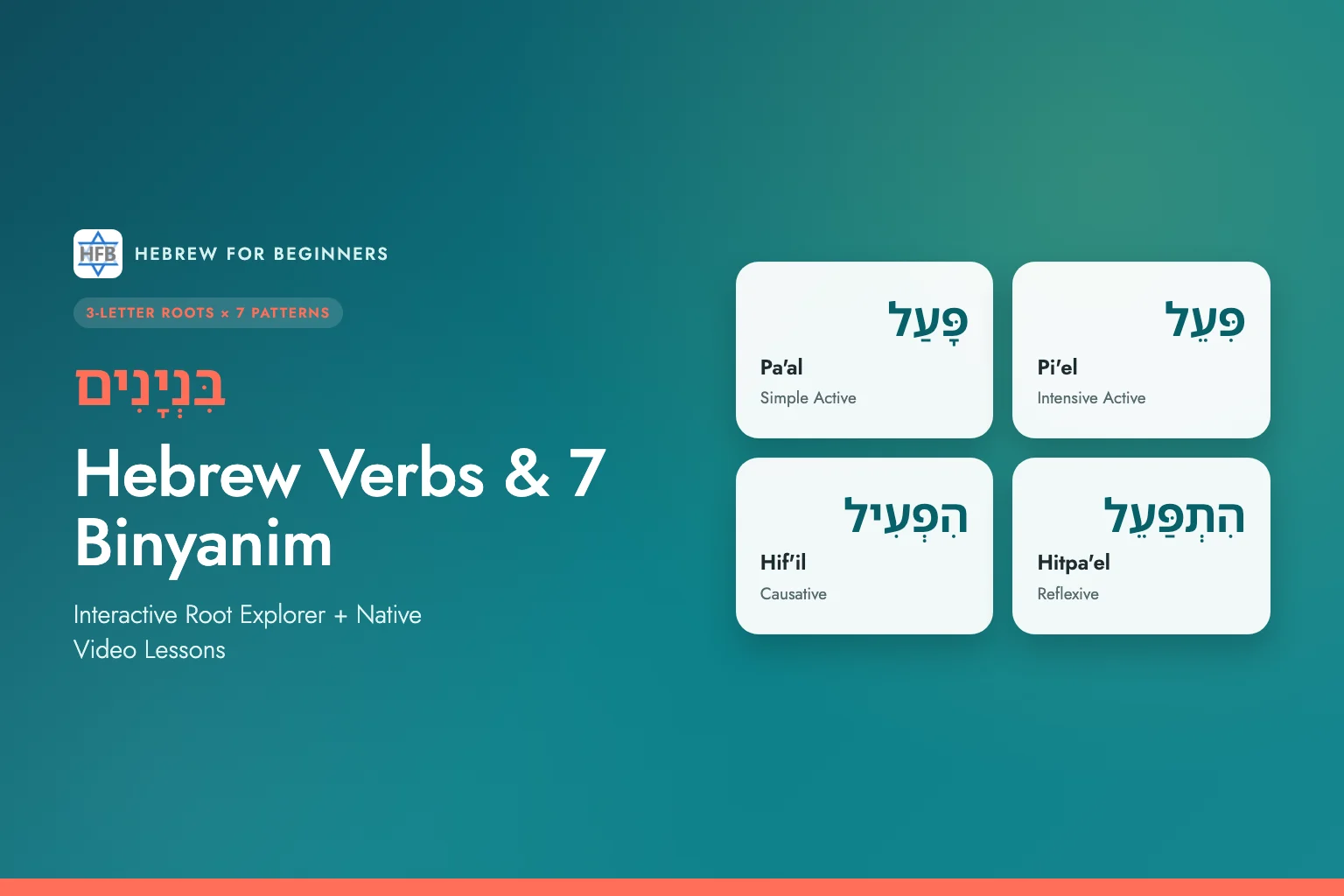
Hebrew verbs look intimidating because one verb can have up to 36 forms across gender, number, person, and tense—yet the entire Hebrew verb system runs on just three-letter roots (שׁוֹרָשִׁים) plugged into seven predictable templates called Binyanim (בִּנְיָנִים). There are no rogue verbs outside those seven patterns.
- 3-letter root (שֹׁרֶשׁ): Carries the core meaning—for example, כ-ת-ב always relates to writing (לִכְתֹּב to write, מִכְתָּב letter, כְּתֹבֶת address).
- 7 Binyanim ("buildings"): Change the grammatical role of that root—simple active (Pa'al), passive (Nif'al), intensive (Pi'el / Pu'al), causative (Hif'il / Huf'al), or reflexive (Hitpa'el).
- Why up to 36 forms? Every verb conjugates for Gender (2) × Number (2) × Person (3) × Tense (3) = 36 slots (though present tense merges into just 4 forms!).
Explore how a single three-letter root shifts meaning across the seven Binyanim in our teacher-verified interactive explorer below—every single Hebrew form is hand-written with accurate vowel signs.
Interactive 3-Letter Root × 7 Binyanim Explorer
Choose a common Hebrew root to see how the seven verb templates transform its meaning across infinitive, present, past, and future.
What is a Hebrew verb root (שֹׁרֶשׁ, shoresh)?
Every Hebrew verb is built around a three-consonant skeleton called a root (שֹׁרֶשׁ, plural שׁוֹרָשִׁים; a small group of modern verbs uses four letters). Those three consonants appear in the same order inside almost every conjugated verb, noun, and adjective in that word family.
Take the root א-כ-ל (a-k-l, eating). Watch how those exact three letters stay locked in order even as prefixes, suffixes, and vowels change around them:
| Form | Say it | Hebrew |
|---|---|---|
| I ate (past, 1st singular) | achalti | אָכַלְתִּי |
| You are eating (present, f. plural) | aten ochlot | אַתֶּן אוֹכְלוֹת |
| They ate (past, 3rd plural) | hem achlu | הֵם אָכְלוּ |
| Food (related noun) | ochel | אֹכֶל |
Why can one Hebrew verb have up to 36 forms?
English verbs barely change (eat, eats, ate, eating). Hebrew packs the pronoun, gender, and tense directly into the verb itself based on four variables multiplied together:
- Gender (2): Masculine or feminine
- Number (2): Singular or plural
- Person (3): 1st (I/we), 2nd (you), or 3rd (he/she/they)
- Tense (3): Past, present, or future
Multiply 2 × 2 × 3 × 3 and you get a theoretical maximum of 36 combinations. In real Hebrew, several slots share the exact same form—for example, the present tense only has 4 forms total (masculine singular, feminine singular, masculine plural, feminine plural), and past-tense "I" (אָכַלְתִּי) and "we" (אָכַלְנוּ) are the same for men and women. Want to test all combinations on לְדַבֵּר (to speak)? Try our Interactive Verb Builder.
The 7 Hebrew Binyanim explained (with video lessons)
The secret that makes Hebrew verbs learnable is that there are only seven verb templates, called Binyanim (בִּנְיָנִים, literally "buildings" or "structures"). Each Binyan is named after how it conjugates the dummy root פ-ע-ל ("to act/do") in the 3rd-person masculine singular past tense ("he did"). Simply swap your verb's three root letters into the פ-ע-ל slots!
| Binyan | Hebrew | Typical Role | Example (כ-ת-ב / ל-ב-שׁ) | Video Lesson |
|---|---|---|---|---|
| 1. Pa'al (Qal) | פָּעַל | Simple active (most common everyday verbs) | כָּתַב (katav, he wrote) · לָבַשׁ (he wore) | Watch Pa'al → |
| 2. Nif'al | נִפְעַל | Passive of Pa'al (or reflexive/inchoative) | נִכְתַּב (nichtav, it was written) | Watch Nif'al → |
| 3. Pi'el | פִּעֵל | Intensive or active transitive | לִמֵּד (limed, he taught) · דִּבֵּר (he spoke) | Watch Pi'el → |
| 4. Pu'al | פֻּעַל | Passive of Pi'el (uses the "u" sound) | לֻמַּד (lumad, it was taught) | Watch Pu'al → |
| 5. Hif'il | הִפְעִיל | Causative active ("to make someone do X") | הִכְתִּיב (hichtiv, he dictated) · הִלְבִּישׁ (he dressed someone) | Watch Hif'il → |
| 6. Huf'al | הֻפְעַל | Passive of Hif'il (uses the "u" sound) | הֻכְתַּב (huchtav, it was dictated) | Watch Huf'al → |
| 7. Hitpa'el | הִתְפַּעֵל | Reflexive or reciprocal ("to do to oneself / each other") | הִתְכַּתֵּב (hitkatev, he corresponded) · הִתְלַבֵּשׁ (he got dressed) | Watch Hitpa'el → |
Want the full big-picture explanation in 5 minutes? Watch our complete Binyanim overview video on our YouTube channel (10,000+ subscribers), and bookmark Pealim.com to look up full conjugation tables for any new verb you meet.
Which Binyanim should beginners learn first?
Do not try to memorize all seven Binyanim at once. Over 80% of everyday spoken Israeli verbs live in just four active Binyanim—learn them in this exact order:
- Pa'al (פָּעַל) first: Everyday verbs like eat (לֶאֱכֹל), write (לִכְתֹּב), go (לָלֶכֶת), love (לֶאֱהֹב), learn (לִלְמֹד).
- Pi'el (פִּעֵל) second: Super regular and packed with daily words like speak (לְדַבֵּר), teach (לְלַמֵּד), pay (לְשַׁלֵּם), cook (לְבַשֵּׁל).
- Hif'il (הִפְעִיל) third: Recognizable by its signature ma- present prefix and hi- past prefix: understand (לְהָבִין), feel (לְהַרְגִּישׁ), start (לְהַתְחִיל).
- Hitpa'el (הִתְפַּעֵל) fourth: Recognizable by hit- / mit-: get dressed (לְהִתְלַבֵּשׁ), call (לְהִתְקַשֵּׁר), use (לְהִשְׁתַּמֵּשׁ).
- Nif'al, Pu'al & Huf'al last: Learn to recognize the passive templates (notice the ni- or u vowel) once your active conversation is rolling.
 Hebrew Grammar: Verbs Master Course
Hebrew verbs from scratch to mastery.
See syllabus & enroll →
Our three Hebrew video courses, rebuilt for iPhone and iPad: video lessons, reading lessons, quizzes and endless practice. Every course has free sections, and one-time purchases unlock the rest, with no subscription. Works offline, syncs your progress through iCloud, and has no account and no ads.

iPhone and iPad only for now. On Android, the same courses are in early access: join early access.
Questions about Hebrew verbs and Binyanim
How many Binyanim (verb patterns) are in Hebrew?
There are exactly seven Binyanim in Hebrew: Pa'al (פָּעַל), Nif'al (נִפְעַל), Pi'el (פִּעֵל), Pu'al (פֻּעַל), Hif'il (הִפְעִיל), Huf'al (הֻפְעַל), and Hitpa'el (הִתְפַּעֵל). Every Hebrew verb belongs to one of these seven templates.
Does every Hebrew root appear in all seven Binyanim?
No. Most roots only use two to four Binyanim in real Modern Hebrew. For example, ל-מ-ד appears in Pa'al (to learn), Pi'el (to teach), Pu'al (to be taught), and Hitpa'el (to apprentice/study), while other combinations simply aren't needed.
How many tenses does Modern Hebrew have?
Modern Hebrew has only three main tenses—past, present, and future—plus an infinitive (שֵׁם פֹּעַל) and imperative (commands). Unlike English, Hebrew has no separate continuous ("am eating" vs. "eat") or perfect ("have eaten") tenses.
What is the easiest way to practice Hebrew verb conjugations?
Master one active Binyan at a time—starting with Pa'al and Pi'el—and drill conjugations out loud. Our Hebrew Grammar: Verbs Master Course (5 hours, 90 lectures on Udemy, and built into our offline Hebrew Master Course iOS app with 38 quizzes) walks through all seven Binyanim step by step.
Why does the Hebrew present tense have only 4 forms?
In Hebrew grammar, the present tense behaves like a participle/adjective—it only cares about gender (masculine/feminine) and number (singular/plural), not person. So "I write", "you write", and "he writes" all use the exact same masculine singular word כּוֹתֵב (kotev)!
Native Hebrew teachers from Israel and co-founders of Hebrew For Beginners (hebrew-for-beginners.com). Since 2012 we have taught Hebrew to over 43,850 students on Udemy, and we built Hebrew Master Course, Hebrew Quiz and Hebrew Alphabet Journey.